
In today’s digital content landscape, maintaining the originality and authenticity of content while utilizing the advancements of artificial intelligence (AI) has become a delicate balancing act. Content creators often find themselves in a conundrum – how to leverage AI’s efficiency without getting penalized by AI detectors. This guide explores the intricacies of using Bypass AI, a leading AI bypasser and humanizer, to seamlessly integrate AI-assisted content into your workflow without falling prey to detection.
Understanding the Need for AI Bypassers and Humanizers
The Role of AI in Content Creation
AI’s role in content creation has grown exponentially, offering unparalleled efficiency, diversity, and creativity. However, this rise has been matched by the development of AI detectors aiming to distinguish AI-generated content from human-made, raising concerns over authenticity and potentially affecting SEO rankings and the credibility of content.
The Emergence of AI Detection Tools
With the advent of AI detection tools, the digital realm initiated a silent tug-of-war between content creators and the platforms scrutinizing the originality of their work. This situation underscored the need for effective AI bypassers and humanizers, tools designed to cloak AI footprints in the content, ensuring it passes as human-generated.
The Mechanics Behind Bypass AI
How Bypass AI Operates
Bypass AI employs sophisticated algorithms that analyze the structure, tone, and style of AI-generated text, transforming it to mimic human writing patterns closely. This process involves a strategic overhaul of certain linguistic patterns that are typically red flags for AI detection tools, effectively making the content undetectable.
Beyond Detection: The Humanizing Effect
What sets Bypass AI apart is not just its ability to bypass AI detection but also its nuanced approach to humanizing content. This AI humanizer injects subtleties and idiosyncrasies associated with human writing into the text, from varying sentence lengths to incorporating idiomatic expressions, thus enhancing its natural appeal and readability.
Step-by-Step Guide to Using Bypass AI
Preparing Your AI-Generated Content
- Content Creation: Begin by generating your content using your AI tool of choice. Ensure the message and information align with your requirements, as Bypass AI focuses on the humanization and undetectability of the text, not on content creation per se.
- Initial Review: Perform a quick review of the generated content. Despite Bypass AI’s capability to enhance text quality, starting with reasonably coherent and well-structured content is advisable.
Utilizing Bypass AI for Humanization
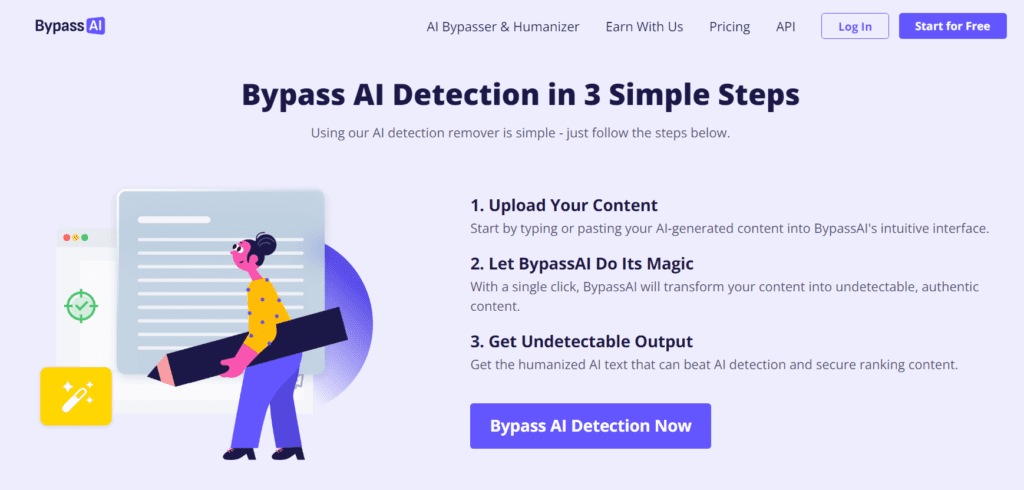
- Accessing Bypass AI: Navigate to the Bypass AI interface. The platform is designed with user-friendliness in mind, requiring no advanced technical knowledge to get started.
- Uploading Content: Copy and paste your AI-generated text into Bypass AI’s interface. This action sets the stage for the transformation process.
- Choosing the Humanization Mode: Select the appropriate mode based on your content’s purpose. Bypass AI offers varied levels and types of humanization, tailoring the process to different content needs.
- Processing the Content: Initiate the humanization process. Bypass AI’s algorithms will meticulously work through the text, applying a series of linguistic and stylistic adjustments to mask its AI origins and enrich its human-like qualities.
- Reviewing and Finalizing: Upon completion, review the humanized content provided by Bypass AI. This step is crucial as it allows you to ensure that the output aligns with your expectations and is ready for publication.
After Humanization: Best Practices
- Incorporating Personal Touches: After utilizing Bypass AI, adding personal anecdotes or customizing the content further can enhance its authenticity.
- Continuous Learning: Engage with the feedback on your content to fine-tune your approach. Bypass AI is a tool that works alongside your evolving content strategy, benefiting from insights gained through real-world application.
Bypass AI: A Multipurpose Tool for Diverse Users
Bypass AI caters to a broad spectrum of users, underscoring its versatility and adaptability across various domains.
- Academic Integrity: For students, Bypass AI offers a way to ensure their AI-assisted research and writing does not conflict with academic integrity policies.
- SEO and Content Marketing: Bloggers and digital marketers find Bypass AI invaluable for maintaining the organic feel of their content, thus avoiding penalties from search engines that could harm visibility and rankings.
- Corporate Communications: Businesses utilizing AI for creating reports, emails, or promotional material can use Bypass AI to maintain a personal touch, reinforcing trust and engagement with their audience.
The Ethical Dimension of Using AI Bypassers
Balancing Efficiency With Authenticity
While the ingenuity of Bypass AI in making AI-generated content undetectable is undisputed, it invites a reflection on the ethical use of such technologies. It’s imperative to balance the efficiency and creativity offered by AI with a commitment to producing authentic, valuable content for readers.
Best Practices for Ethical Usage
- Transparency: Be upfront about using AI tools where appropriate, especially in sensitive areas such as educational content or journalistic writing.
- Adding Value: Ensure that the use of AI and tools like Bypass AI enhances the content’s value to the reader, rather than merely circumventing detection for superficial gains.
Conclusion: Embracing AI With Responsibility
Bypass AI emerges as a pivotal tool for content creators navigating the complex interplay between AI’s potential and the need for authenticity in digital content. By understanding how to use this AI bypasser and humanizer effectively, creators can harness AI’s power while ensuring their content remains undetectable, engaging, and, most importantly, true to the human experience.
In the journey toward embracing AI in content creation, Bypass AI stands out as a beacon, guiding users through the challenges of detection and the ethical nuances of AI integration. Its role is not to mask the use of artificial intelligence but to ensure that the resulting content retains the warmth, complexity, and depth that only human touch can impart.

